For most real estate valuation models, the biggest bottleneck is data, not logic. Even the strongest underwriting frameworks depend on timely, consistent comparable property data, so analysts spend hours gathering and reconciling fragmented datasets. As portfolios scale, manual workflows slow decisions, introduce inconsistencies, and limit the ability to evaluate deals efficiently.
A real estate comps API changes this process by delivering structured comparable sales and rental data automatically, enabling faster valuation models and more reliable DSCR analysis. Now, investors and developers can integrate market intelligence directly into their tools and workflows. In this guide, we’ll explain how comps APIs work, how Mashvisor supports smarter valuation and underwriting models, what specific endpoints are available, and how businesses can use automated comparable property data to build scalable real estate analytics solutions.
Key Takeaways
- Comparable property data is the foundation of accurate real estate valuation and DSCR modeling.
- APIs automate comp analysis, eliminating manual research and spreadsheet-based workflows.
- Mashvisor combines sales comps, rental comps, and investment metrics in a single analytics-ready dataset.
- Automated comps data enables scalable valuation models for investors, lenders, and PropTech platforms.
- Developers can integrate real estate intelligence directly into underwriting and analytics tools using API endpoints.
How Comparable Property Data Powers Modern Valuation Methods
Comparable property data powers property valuation methods in real estate by allowing investors and analysts to estimate the fair market value (FMV) and income potential based on similar nearby properties. By analyzing recent sales and rental performance, comps provide market-based benchmarks to compare deals against.
What Are Real Estate Comps?
Real estate comps, short for real estate comparables, are properties with similar characteristics, such as location, size, property type, and condition, that are used to estimate the value of a property under investigation. Traditionally, comps focus on recent sales, but investment property analysis also relies heavily on rental comps to evaluate income properties.
Thus, the two main types of comps are:
- Sales comps: Recently sold properties used for real estate appraisal
- Rental comps: Comparable rental listings used to project income and occupancy
Together, these comps form the foundation of solid pricing, underwriting, and investment analysis. That’s why access to structured comparable sales data becomes particularly important for investors building repeatable valuation frameworks across multiple markets.
Limitations of Manual Comp Analysis
While comps are central to valuation, the traditional process is difficult to scale. That’s because you have to rely on manual searches across listing platforms, local databases, and spreadsheets.
The following challenges emerge quickly:
- Time-consuming data collection
- Inconsistent comparison criteria
- Limited access to rental performance metrics
- Difficulty analyzing multiple markets simultaneously
- Lack of automation for portfolio-level analysis
These limitations become more significant for those analyzing deals at scale. So, valuation workflows increasingly depend on automated data delivery through APIs, which allow the instant retrieval of comps data and direct integration into analytical models.
What Is a Real Estate Comps API and How Does It Work?
A real estate comps API automatically delivers comparable property data, such as recent sales, pricing benchmarks, and property characteristics, through structured requests instead of manual research. Users send a query based on location or property criteria, and the API returns standardized comps data that can be readily used in valuation and underwriting models.
From Static Reports to Automated Valuation
Traditional comp analysis relies on static reports or manual searches that must be repeated for every property. A comps API replaces manual underwriting with automated data retrieval.
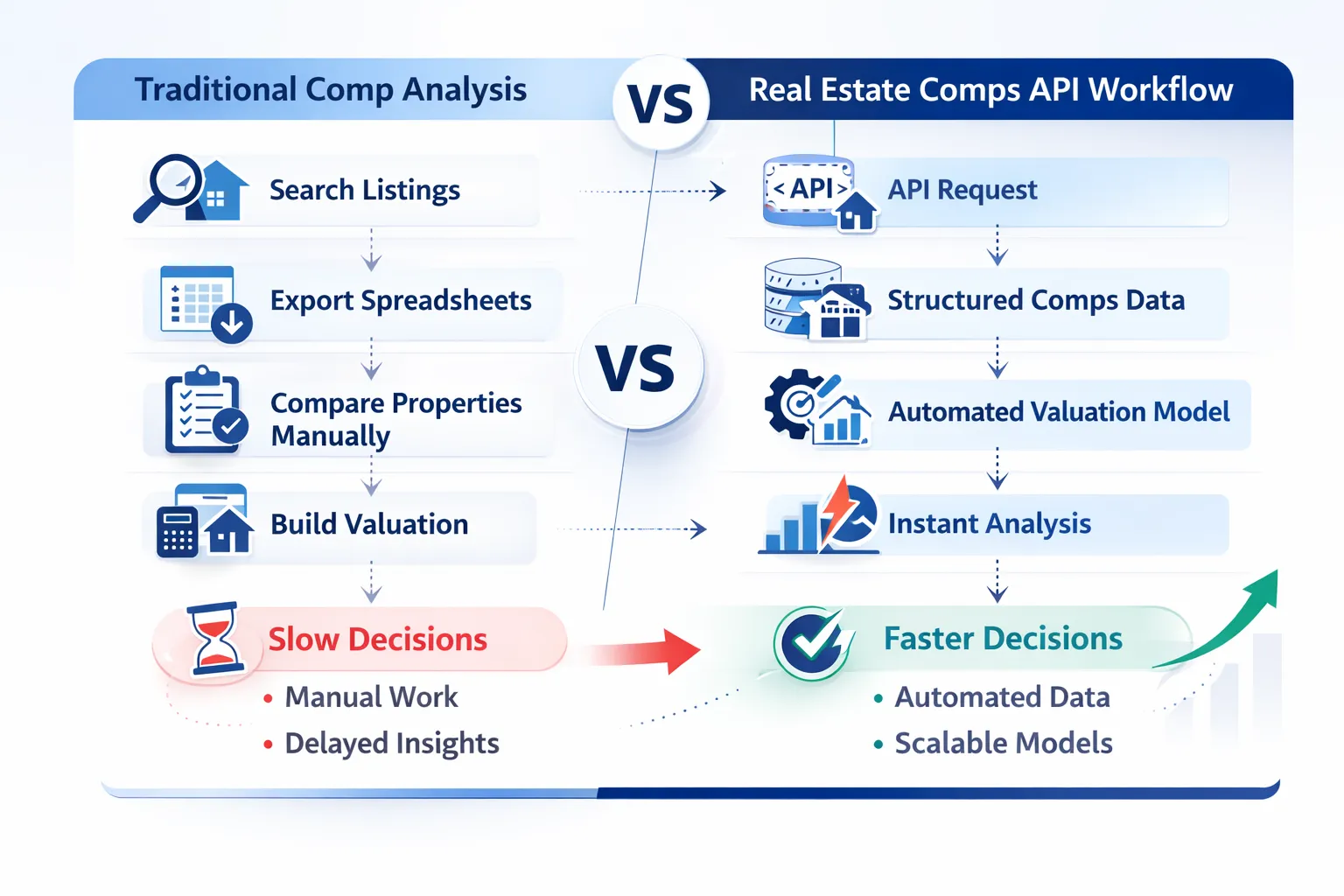
At a high level, the automated workflow looks like this:
- A user or an app sends a request (city, address, or property attributes).
- The API identifies comps using predefined similarity criteria.
- The API returns structured data, including pricing benchmarks and property details.
- The data feeds directly into valuation models or analytics dashboards.
With the help of property comps data API, investors and platforms can pull updated datasets on demand. Because the data arrives in a standardized format, it can be used immediately to build repeatable valuation logic across different property types and markets.
Where a Real Estate Valuation API Fits in Modern Tech Stacks
Comparable property data is increasingly embedded directly into software workflows rather than analyzed separately.
A real estate valuation API acts as a data layer powering tools used by:
- Real estate investors analyzing acquisitions at scale
- Brokerages building pricing and CMA tools
- Lenders evaluating collateral risk
- Property analytics platforms automating rental property analysis
- PropTech startups developing automated valuation models (AVMs)
For those on the tech side, a real estate API for developers eliminates the need to aggregate raw listing datasets or maintain complex data pipelines. Instead, an automated property valuation API provides ready-to-use comps data that integrates into underwriting systems, dashboards, or investment analysis platforms.
Mashvisor Real Estate Comps API: Data, Endpoints, and Features
A comparable sales data API is only as useful as the quality and structure of the data it delivers. The Mashvisor API provides comparable property datasets enriched with market benchmarks, investment analytics, and performance indicators, unified into a single real estate analytics API. This allows users to move directly from raw comps to valuation and underwriting without additional data processing.
Read further to find out exactly what the Mashvisor API is.
Key Data Points Available Through Mashvisor API
Mashvisor delivers structured comparable property data that supports real estate valuation models, pricing analysis, and investment decision-making.
Property-Level Comparable Data
- Property address and location data
- Listing and estimated property value
- Property type: Single-family, condo, or multifamily
- Number of bedrooms and bathrooms
- Square footage and lot size
- Price per square foot
- Days on market
- Listing status and historical pricing signals
Market and Investment Context
- Median property prices in the area
- Market appreciation trends
- Estimated operating expenses
- Cap rate benchmarks
- Cash on cash return estimates
- Neighborhood performance indicators
These endpoints allow users to integrate a real estate investment analysis API directly into acquisition or real estate underwriting pipelines.
Example Mashvisor API Endpoints
Mashvisor provides comparable property data through a number of endpoints.
Common API endpoints used in comparable property analysis:
GET /v1.1/client/property
GET /v1.1/client/property/nearby
GET /v1.1/client/property/transactions
GET /v1.1/client/property/price-estimates
💡 Check out the Mashvisor API documentation for all available endpoints.
How endpoints support analysis:
- /property: Baseline property details for valuation
- /property/nearby: Comparable properties with similar characteristics
- /property/transactions: Historical sales data for price validation
- /property/price-estimates: Market-based valuation benchmarks
Combined, these endpoints enable a fully automated comps workflow that replaces manual research with structured data retrieval.
Example Request: Retrieving Comparable Properties
The following example shows how a developer might request nearby comparable properties for valuation analysis using the Mashvisor API:
GET https://api.mashvisor.com/v1.1/client/property/nearby?state=AZ&city=Phoenix&address=123+Main+St
Headers:
x-api-key: YOUR_API_KEY
This request retrieves nearby properties that can be used as real estate comps for valuation modeling.
Simplified Example Response
The API returns structured comparable property data that can be directly integrated into valuation or underwriting models, as you can see below:
{
“subject_property”: {
“address”: “123 Main St”,
“property_type”: “Single Family”,
“price_estimate”: 420000
},
“nearby_properties”: [
{
“address”: “118 Main St”,
“sale_price”: 415000,
“beds”: 3,
“baths”: 2,
“distance_miles”: 0.3
},
{
“address”: “140 Oak Ave”,
“sale_price”: 432000,
“beds”: 3,
“baths”: 2,
“distance_miles”: 0.6
}
]
}
The data is returned in a standardized JSON structure, so it can immediately power valuation dashboards and automated underwriting tools without manual formatting.
👉 Book a free demo with the Mashvisor Data Team to see how comparable property data integrates directly into valuation and underwriting workflows.
Building Smarter Valuation & DSCR Models Using Mashvisor Data
Real estate valuation and DSCR models become more accurate and scalable when comparable property data is integrated directly into analysis workflows. By automating comps retrieval through an API, investors and developers can standardize assumptions, reduce manual research, and evaluate properties using consistent market benchmarks.
How to Build a Property Valuation Model Using Comparable Data
Accurate valuation models rely on comparable sales to estimate fair market value based on observable market behavior rather than subjective pricing assumptions. Using API-delivered comps allows this process to be repeated automatically across multiple properties and markets.
A simplified workflow to build a real estate valuation model looks like this:
- Retrieve subject property data: Pull property characteristics, such as size, type, and location.
- Fetch comparable properties: Use nearby property data to identify similar recent sales.
- Normalize comparison factors: Adjust for differences in square footage, bedrooms, or property type.
- Calculate pricing benchmarks: Derive metrics, such as median sale price or average price per square foot.
- Generate valuation estimate: Apply benchmarks to estimate the investigated property’s market value.
As comps get delivered through an API for real estate valuation, the model can run automatically whenever new properties are analyzed. This enables consistent valuation at scale.
Using Comps Data for DSCR Model Real Estate Analysis
The debt-service coverage ratio (DSCR) model depends on realistic income and valuation assumptions. Comparable property data improves DSCR accuracy by grounding projections in verified market activity.
DSCR Calculation Formula
DSCR = Net Operating Income/Total Debt Service
To calculate DSCR for a rental property, analysts typically:
- Estimate property value using sales comps
- Project income using market benchmarks
- Calculate operating expenses
- Compare the net operating income (NOI) against loan payments
Accurate comps reduce risk by preventing overestimated valuations or unrealistic income assumptions – two of the most common underwriting errors.
Automating Rental Property Underwriting Workflows
When comparable property data is delivered programmatically, underwriting can shift from manual review to automated evaluation.
A typical automation pipeline looks like:
API → Valuation model → DSCR calculation → Investment decision
This form of rental property underwriting automation allows platforms to:
- Analyze deals instantly
- Screen large property datasets
- Maintain consistent risk criteria
- Scale investment analysis across markets
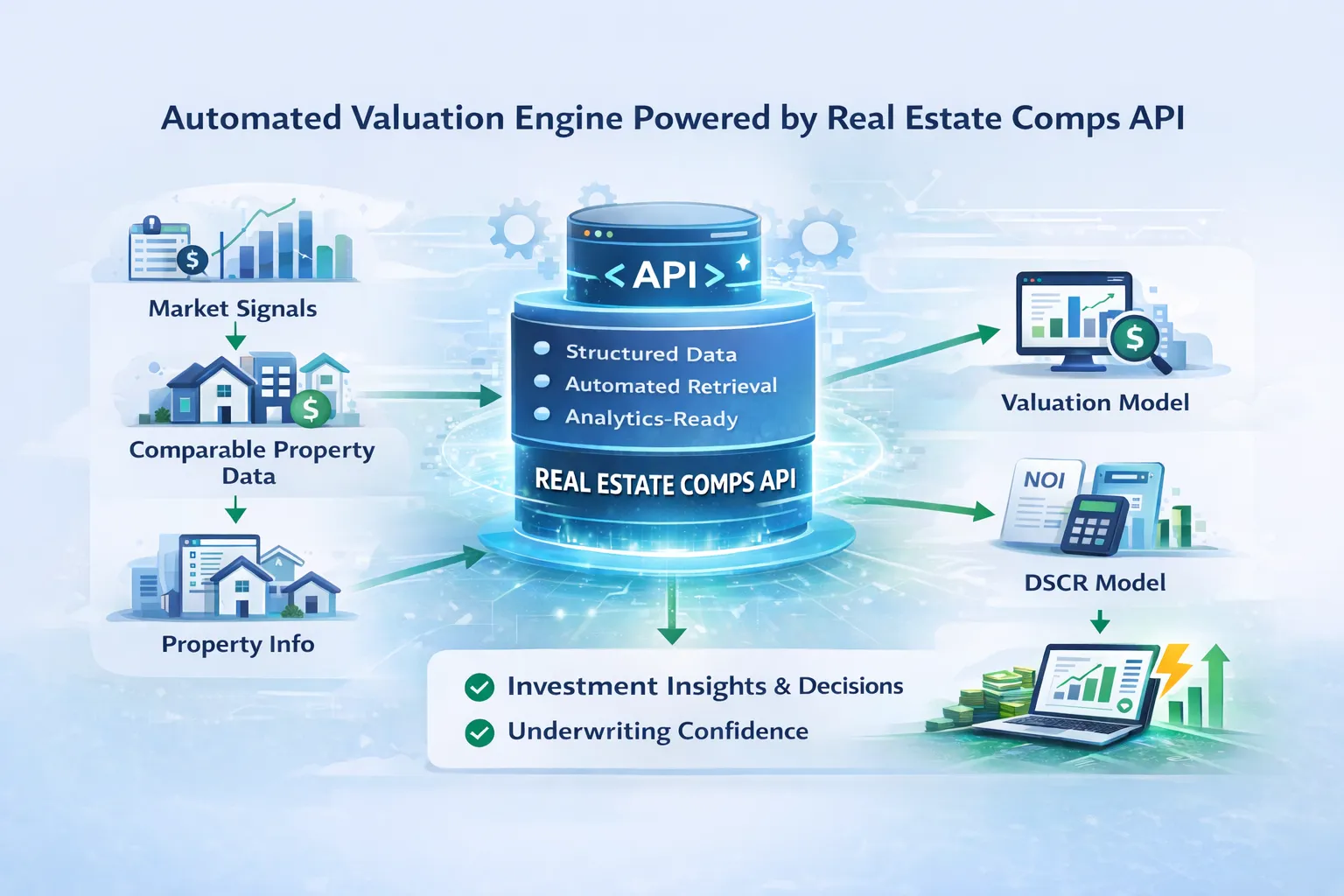
Instead of building data infrastructure from scratch, teams can rely on a real estate data API partnership to supply standardized comps data ready for modeling.
Real-World Example: Example: Automating DSCR-Based Loan Underwriting
Consider a lender evaluating a rental property loan application. Instead of relying on manual appraisals and spreadsheets, the system pulls comparable property data through an API as soon as a property is submitted.
The workflow runs automatically:
- The API retrieves nearby sales comps to estimate property value.
- Rental comps are used to project income and occupancy.
- The system calculates NOI and applies the DSCR formula.
- The loan decision is flagged based on predefined risk thresholds.
In this setup, what previously took hours or days becomes a repeatable, near-instant process. More importantly, every deal is evaluated using consistent, data-driven criteria rather than subjective assumptions.
While this example highlights a typical underwriting workflow, it’s just one of many ways a real estate comps API can be applied in practice.
Real-World Use Cases for Investors, Developers, and PropTech Teams
A real estate comps API is most valuable when integrated into real decision-making workflows.
Here are how different types of users benefit from it to optimize processes:
Investors and Acquisition Teams
Real estate investors use comparable property data to evaluate deals faster and more consistently across markets.
Common applications include:
- Estimating fair purchase price
- Comparing multiple investment opportunities
- Validating asking prices against market comps
- Analyzing portfolio expansion opportunities
Access to a centralized real estate comps dataset allows investors to standardize decision criteria and reduce bias in deal evaluation.
Lenders and DSCR Underwriting
Lenders increasingly rely on automated data workflows to evaluate borrower risk and collateral value.
With API-delivered comps, lenders can:
- Verify valuation inputs programmatically
- Support faster loan approvals
- Improve underwriting consistency
- Reduce manual appraisal dependency for preliminary analysis
This approach aligns with broader industry trends towards automated underwriting powered by historical real estate data APIs.
PropTech Platforms and Developers
For startups and analytics platforms, comparable property data serves as a foundational data layer powering valuation and analytics tools.
Typical developer use cases include:
- Automated valuation models (AVMs)
- Investor dashboards and deal analyzers
- Brokerage pricing tools
- Portfolio analytics platforms
With the help of the best real estate data API, teams can launch valuation features without building or maintaining complex property data pipelines internally.
Mashvisor API Pricing and Getting Started
The Mashvisor API pricing follows a usage-based model, allowing companies to scale API access as their data needs grow. This makes it suitable for both early-stage projects and enterprise platforms.
Mashvisor offers monthly and annual plans, with annual subscriptions providing two months free.
The pricing structure includes tiered plans designed for different stages of growth:
- Starter: Best for testing and early development
- Growth: Suitable for production applications and growing platforms
- Professional: Designed for advanced analytics and higher usage volumes
- Enterprise: Right for custom solutions and large-scale integrations
👉 To get started, schedule a consultation call with the Mashvisor Data Team.
Benefits of Using Mashvisor for Automated Property Valuation
Using the Mashvisor API for comparable property analysis helps investors and developers move from manual valuation workflows to scalable, data-driven decision-making.
Here are the exact advantages that you can expect:
- Nationwide comparable property coverage supporting consistent valuation across multiple markets
- Structured real estate comps data ready for immediate use in valuation and underwriting models
- Integrated investment analytics that reduce the need for additional calculations or datasets
- Automation-ready architecture designed for real estate platforms and internal tools
- Scalable real estate data API that grows with portfolio size and application usage
- Developer-friendly integration through documented Mashvisor API endpoints
By combining comparable property data with investment analytics in one platform, Mashvisor enables faster, more reliable property valuation at scale.
While these benefits make comps APIs powerful, they’re not always necessary for every use case.
When a Real Estate Comps API May Not Be Necessary
A real estate comps API is most valuable when you need to analyze properties at scale or integrate valuation directly into software workflows. However, it’s not always necessary for every use case.
You may not need a comps API if:
- You’re analyzing a single property occasionally: Manual research through listing platforms may be sufficient.
- You don’t require automation: Spreadsheet-based analysis can work for small portfolios.
- You’re not building a product or internal tool: APIs are most useful when integrated into repeatable systems.
- You rely on traditional appraisals only: In some cases, manual valuation processes are still preferred.
In these scenarios, using an API may add unneeded complexity. But as soon as you need faster analysis, consistent benchmarks, or simultaneous evaluation of multiple properties, automated comps data becomes significantly more valuable.
Bottom Line
As real estate analysis becomes increasingly data-driven, valuation and underwriting are shifting from manual research towards automated intelligence. In this context, property comps data serves as a continuous input powering pricing models, risk evaluation, and investment decisions across portfolios rather than a one-time analysis performed for individual deals.
A real estate comps API enables this transition by delivering consistent market data directly into automated valuation and DSCR models. This helps teams analyze opportunities faster while maintaining standardized assumptions.
With scalable access to comparable properties, investment metrics, and analytics-ready datasets, Mashvisor allows investors, lenders, and PropTech platforms to focus less on data collection and more on building smarter real estate strategies.
💡 Ready to build smarter valuation and DSCR models? Start a 7-day free trial of the Mashvisor API for access to 30 credits.
FAQs
What Is a Real Estate Comps API?
A real estate comps API provides programmatic access to data on similar properties in a given area. This allows apps to retrieve sales and market comparisons automatically.
How Is DSCR Calculated for Rental Properties?
The debt-service coverage ratio is calculated by dividing a property’s net operating income (NOI) by its total annual debt obligations. In this way, it measures whether a property’s income can cover loan payments and helps lenders evaluate repayment risk.
Who Uses Real Estate Comps APIs?
Comparable property APIs are commonly used by real estate investors, lending institutions, brokerages, and PropTech platforms that need scalable valuation data for analysis, reporting, or automated real estate analysis systems.
What Makes Mashvisor Different from Other Real Estate APIs?
Mashvisor focuses on investment-oriented analytics by combining property information with market insights and performance indicators. This means that users can evaluate opportunities without assembling multiple separate datasets.
How Do I Get Comparable Property Data Automatically?
Comparable property data can be accessed by connecting analytical software tools to a data provider’s API, which returns nearby property information and pricing benchmarks through automated requests based on location or property characteristics.