
Turning your home into a rental property can sound like a smart move, especially if you are moving out but not ready to sell.
Maybe you locked in a low mortgage rate a few years ago. Maybe your local market still has strong rental demand. Or maybe you believe the home will continue appreciating and want to hold onto it while generating monthly income.
All of those can be valid reasons to rent instead of sell. But before you hand the keys to a tenant, you need to answer a bigger question:
Is the property truly rental-ready?
That means more than cleaning the house, repainting a few walls, and taking listing photos. A rental-ready property should be physically prepared, financially realistic, legally compliant, and aligned with what renters in the local market actually want.
We asked Daryl Fairweather, Chief Economist at Redfin, how homeowners should think about the broader decision to rent out instead of sell. Her advice was clear: start with the tradeoff.
“The first thing to consider is what you’re giving up by renting instead of selling,” Fairweather said. “Selling gives you access to your equity right away, while renting means keeping that money tied up in the home in exchange for potential rental income and future appreciation.”
Neither is necessarily bad, but the choice should be intentional. This tradeoff is where every homeowner should begin.
Before you become a landlord, here are the numbers to run, upgrades to consider, and common mistakes to avoid.
1. First, Decide Whether Renting Makes Financial Sense
Before preparing the property itself, homeowners should decide whether keeping it as a rental is actually the right financial move.
Start with three questions:
- What could the home sell for today?
- What could it realistically rent for?
- Would the rental income cover your true monthly and long-term costs?
A common mistake is comparing only the rent and mortgage payment. If the rent is higher than the mortgage, the property may look profitable at first glance. But that is not the full picture.
As Fairweather explained, homeowners also need to account for “taxes, insurance, maintenance, vacancies, and property management.” If the numbers only work when the home is fully occupied, repairs are minimal, and prices keep rising, renting may be riskier than it looks.
A rental property should make sense under realistic conditions, not perfect ones.
That means your analysis should include:
- Mortgage payment
- Property taxes
- Homeowners insurance or landlord insurance
- Maintenance and repairs
- Vacancy allowance
- Property management fees
- HOA dues, if applicable
- Utilities you may still cover
- Turnover costs
- Local licensing or permit costs
- Short-term rental compliance costs, if relevant
2. Study Local Rental Demand Before Listing
A home can be beautiful, updated, and well-maintained, but if local rental demand is weak, it may still sit vacant or underperform.
Before listing, homeowners should evaluate the rental market the same way an investor would.
Look at:
- Local vacancy rates
- Recent rent growth
- Comparable rental listings
- How long similar homes stay on the market
- Job growth and employment stability
- Population and migration trends
- Nearby new apartment construction
- School quality and neighborhood amenities
- Access to transit, highways, shopping, and employment centers
Fairweather noted that renting can be more attractive in markets where rental demand is strong, vacancies are low, and rents are high enough to comfortably cover ownership costs.
That point is important. A strong rental market is not just a place where rents are high. It is a place where renter demand is deep enough to support consistent occupancy.
For long-term rentals, demand is often driven by jobs, schools, affordability, and neighborhood stability. For short-term rentals, demand depends more on tourism, seasonality, attractions, events, and local regulations.
Before moving out, homeowners should know which type of demand their property is likely to attract.
3. Set the Right Rental Price From the Beginning
Pricing is one of the most important parts of rental readiness.
Many first-time landlords price based on emotion. They think about what they paid for the home, how much they love it, or what they need the rent to be in order to feel comfortable keeping it.
But the market does not care what you need. It responds to comparable properties, location, condition, amenities, and demand.
To determine the right rental price, compare your property with similar rentals nearby. Focus on homes with similar:
- Bedroom and bathroom count
- Square footage
- Property type
- Condition
- Parking
- Outdoor space
- School district
- Access to transit or major employers
- Included utilities or amenities
For short-term rentals, look at comparable listings by occupancy, nightly rate, reviews, amenities, and seasonality. For long-term rentals, focus on monthly rent, lease terms, days on market, and renter demand.
Pricing too high can create a vacancy problem. A landlord may think they are protecting income by asking for more, but one or two vacant months can easily erase the benefit of a higher rent.
In many cases, a realistic price from day one leads to better total returns than waiting for an unrealistic number.
4. Fix Safety, Functionality, and Maintenance Issues First
Before thinking about cosmetic upgrades, start with the basics.
A rental-ready home should be safe, functional, and easy to maintain.
That includes:
- Working locks on all exterior doors
- Smoke and carbon monoxide detectors
- Safe electrical systems
- Functional plumbing
- Reliable heating and cooling
- Clean appliances
- No leaks or moisture issues
- Secure windows
- Proper exterior lighting
- Clear entryways and walkways
- Pest control, if needed
These are not exciting upgrades, but they matter. Tenants expect the property to work from day one. And landlords who ignore maintenance before move-in often end up paying for bigger problems later.
Preventive repairs also help create a smoother tenant experience. A renter who moves into a well-prepared home is less likely to be frustrated, submit frequent complaints, or leave quickly.
For homeowners who are moving away from the property, this is even more important. Once you are no longer living nearby, every small issue becomes harder to handle.
5. Choose Durable Materials Over Personal Design Choices
One of the biggest mistakes homeowners make before renting out a property is over-improving it.
A rental does not need to match the owner’s personal dream home. It needs to be attractive, durable, and appropriate for the target renter.
Instead of expensive custom finishes, focus on materials that can handle regular use and are easy to clean or replace.
Good rental-friendly upgrades include:
- Luxury vinyl plank flooring
- Neutral paint colors
- Durable countertops
- Easy-to-clean backsplashes
- Simple, modern fixtures
- Low-maintenance landscaping
- Reliable appliances
- Energy-efficient lighting
- Smart thermostats
- Functional storage
For long-term rentals, durability is often more important than style. Tenants want a comfortable, practical home. Landlords need materials that reduce turnover costs.
For short-term rentals, presentation matters more. Guests expect the property to feel polished, clean, and thoughtfully designed. But even then, durability still matters because turnover is frequent.
The goal is not to spend the most money. The goal is to spend money where it reduces vacancy, improves tenant satisfaction, and protects long-term profitability.
6. Prepare Differently for Short-Term vs. Long-Term Rentals
Short-term and long-term rentals require different preparation.
A long-term rental should feel like a clean, functional home that a tenant can make their own. It does not usually need to be furnished, but it does need reliable systems, durable finishes, good storage, and clear lease terms.
A short-term rental is closer to a hospitality business. It needs to be fully furnished, guest-ready, and operational from day one.
For a short-term rental, homeowners may need:
- Furniture
- Mattresses and bedding
- Towels and linens
- Kitchenware
- Coffee setup
- Wi-Fi
- Smart lock or self check-in
- Cleaning schedule
- Guest instructions
- Restocking process
- Professional photos
- Review management
- Local compliance and permits
Short-term rentals also experience more frequent turnover. That means more cleaning, more guest communication, and more small maintenance issues.
Long-term rentals generally have less day-to-day work, but problems can build over time if tenants do not report them early.
Before choosing a strategy, homeowners should be honest about how much time, energy, and management they are willing to take on.
7. Put Systems in Place Before the First Tenant Moves In
A rental-ready property also needs rental-ready operations.
Before listing the home, homeowners should decide how they will manage:
- Tenant screening
- Lease signing
- Rent collection
- Maintenance requests
- Emergency repairs
- Move-in and move-out inspections
- Security deposits
- Property documentation
- Cleaning and turnover
- Communication with tenants or guests
Even if you hire a property manager, you should understand the process. Who handles repairs? How quickly are tenants contacted? How are expenses approved? How often will you receive statements?
For short-term rentals, systems are even more important. You need a repeatable process for every stay: check-in, cleaning, restocking, guest messaging, issue resolution, and review follow-up.
A smooth system protects the tenant experience and reduces stress for the owner.
8. Understand the Regulations Before You Commit
Regulations can make or break a rental strategy.
Long-term rentals may be subject to local landlord-tenant laws, security deposit rules, inspection requirements, rent control, eviction regulations, and licensing rules.
Short-term rentals may face zoning restrictions, permit requirements, occupancy taxes, platform rules, HOA restrictions, or outright bans.
Before moving out, homeowners should confirm what is allowed in their city, county, neighborhood, and HOA.
This is especially important for owners considering Airbnb or other short-term rental platforms. A property that looks profitable on paper may not be legally rentable as a short-term rental.
Check your local short-term rental regulations now.
Do this research before you furnish the property, hire a photographer, or build your income projections.
9. Do Not Assume Appreciation Will Save the Deal
Another common mistake is assuming that home prices and rents will always rise enough to make the property worth holding.
Fairweather cautioned against relying on appreciation to justify weak numbers. A rental property should make financial sense based on realistic assumptions today, not only the hope that home values will climb quickly later.
That matters in today’s market. Affordability remains stretched, mortgage rates are still elevated, and rent trends vary by market.
Some homeowners may still be in a strong position, especially if they purchased before rates increased and have a low mortgage payment. Fairweather noted that holding and renting can make sense for homeowners who locked in a low mortgage rate early in the pandemic and would be giving up inexpensive financing by selling.
But even then, the property still needs to work as a rental.
Low debt costs help, but they do not eliminate vacancy, maintenance, insurance, taxes, or market risk.
Learn More: Cash Flow vs Appreciation: What Should Drive Your Decision?
10. Final Rental-Ready Checklist
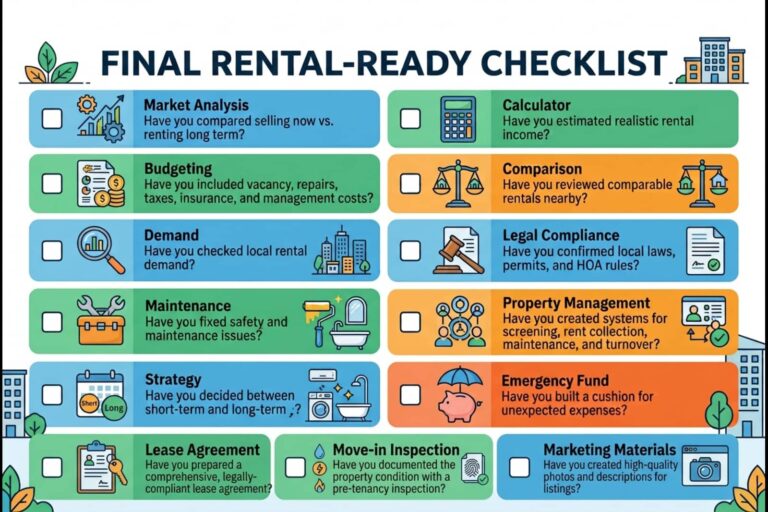
Before renting out your home, make sure you can answer “yes” to these questions:
- Have you compared selling now vs. renting long term?
- Have you estimated realistic rental income?
- Have you included vacancy, repairs, taxes, insurance, and management costs?
- Have you reviewed comparable rentals nearby?
- Have you checked local rental demand?
- Have you confirmed local laws, permits, and HOA rules?
- Have you fixed safety and maintenance issues?
- Have you chosen durable, renter-friendly upgrades?
- Have you decided between short-term and long-term rental strategy?
- Have you created systems for screening, rent collection, maintenance, and turnover?
- Have you built a cushion for unexpected expenses?
If the numbers only work under ideal conditions, pause before listing.
If the property can support realistic expenses, attract steady demand, and operate smoothly, it may be ready to become a rental.
The Bottom Line
Preparing your home for renters before moving out is not just about making it look nice. It is about making sure the property is financially sound, operationally ready, and aligned with local renter demand.
Selling may give you immediate access to equity. Renting may provide income and long-term upside. The right choice depends on your market, mortgage, property condition, rental demand, and risk tolerance.
Before deciding, run the numbers carefully.
Mashvisor helps homeowners and investors compare rental income, cash flow, cap rate, cash-on-cash return, occupancy, and local market performance for both short-term and long-term rental strategies.
If you are thinking about turning your home into a rental, start with the data. A good rental decision is not based on hope. It is based on realistic numbers, local demand, and a property that is truly ready for tenants.