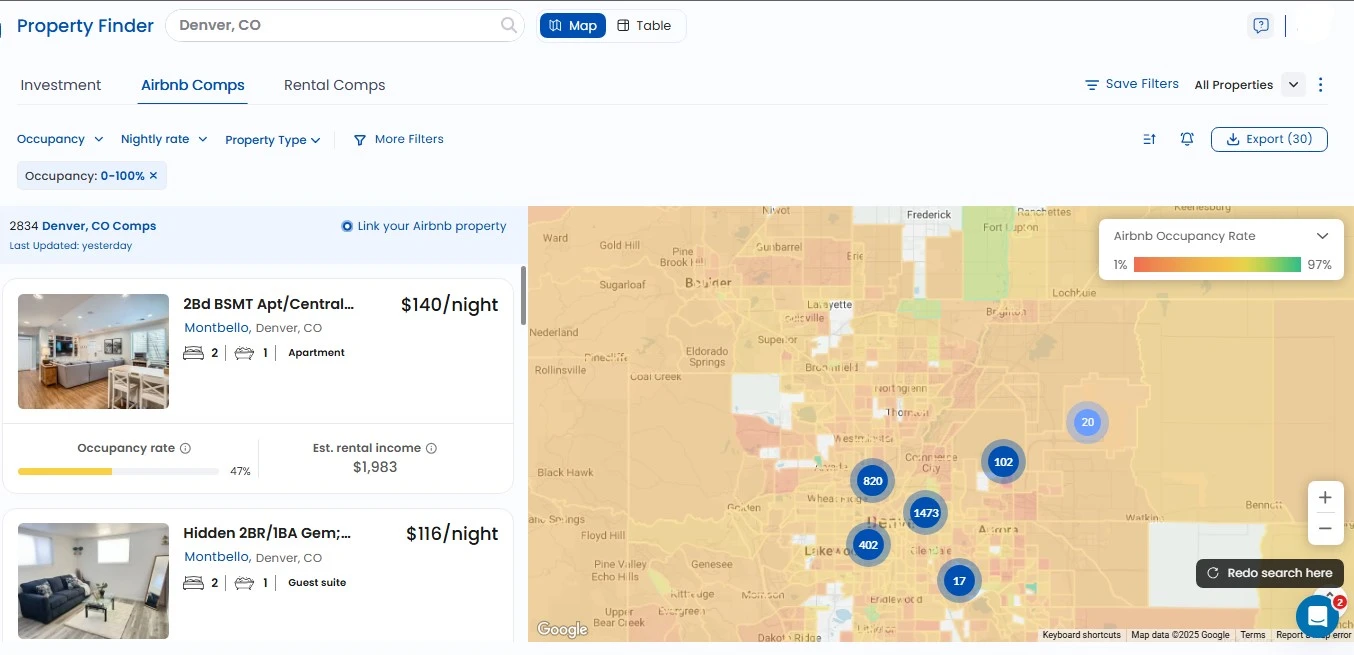
If you’re exploring Airbnb investing—whether as a beginner or someone expanding a portfolio—one question matters more than almost any other:
“How often will this property actually get booked?”
That’s what the occupancy rate tells you. However, getting the real number isn’t always easy. Property calendars can sometimes be misleading. Airbnb doesn’t publish actual booking data, and relying on scattered listings often leads to inaccurate assumptions.
This is where an Airbnb Occupancy Rate API (Application Programming Interface) becomes incredibly valuable. Instead of guessing or piecing together information, you can pull verified booking patterns, market trends, and property-level insights instantly.
Key Takeaways:
- Occupancy rate is a make-or-break metric for investing in a rental property.
- APIs offer far more reliable data than manually reviewing Airbnb calendars.
- A strong occupancy API includes ADR, revenue estimates, comps, and long-term rental data, not just occupancy rate alone.
- You can use these tools for market research, property evaluation, and building custom Airbnb investment analytics for more efficient investing.
What Is Airbnb Occupancy Rate and Why Does It Matter?
Before we go any deeper into the discussion about APIs, we need to understand some of the basics first.
What Is an Occupancy Rate?
Simply put, an occupancy rate is the percentage of available days that a property is actually booked.
- Occupancy Rate = Booked Nights ÷ Available Nights
For example, if a listing is available for 30 days and gets booked for 21:
- 21 booked nights ÷ 30 available nights = 70% occupancy rate
It’s important to note that there is a huge difference between booked and blocked nights. And unbooked blocked dates do not count as part of the available dates on listings. Booked nights mean paying guests stayed. Blocked nights usually mean the host has set the calendar to unavailable. Owners block certain dates for various reasons, including personal use, maintenance, and renovations.
Whatever the reasons are, these blocked dates don’t generate income and do not count as part of occupancy. A good API takes owner-blocked nights out of the equation so that the occupancy rate isn’t inflated. That said, occupancy rates are applied to both long-term and short-term rentals.
Related: Airbnb Occupancy Rate: What It Is & What to Expect in 2025
Why Does Accurate Occupancy Data Matter?
Accurate occupancy data helps you:
- Estimate revenue realistically
- Compare different cities and neighborhoods
- Understand how seasons affect demand
- Evaluate whether Airbnb beats long-term renting in a particular market
- Avoid markets that “seem popular” but underperform in reality
If all you did was rely on incomplete data and lots of guesswork, your occupancy estimate is off. And when that is off, everything else—cash flow, ROI, pricing—falls out of place.
How Do Airbnb Occupancy Rate APIs Work?
Let’s now get into the APIs. An API is a tool that lets different software systems talk to and exchange information with each other. Think of it as a messenger: you ask for specific data (such as occupancy rates and nightly prices), the API retrieves it from the source, and delivers it back in a format that you can easily use in apps, spreadsheets, or dashboards.
Where Does the Data Come From?
Airbnb occupancy APIs typically combine the following:
- Active listings and their calendars
- Historical booking patterns
- Seasonal demand data
- Market-level behavior across entire cities and ZIP codes
- Regular, automated updates
Instead of sampling a few listings, you get to see the bigger picture of the market you’re studying.
How Is the Data Cleaned and Verified?
A reliable API gives you accurate, consistent, and up-to-date occupancy information by doing the following:
- Removes duplicate and inactive listings
- Identifies blocked days vs actual bookings
- Uses algorithms to fill in gaps responsibly
- Checks trends against a multi-year history
- Considers guest reviews and feedback
- Updates the dataset often (within 36-48 hours)
Why Sample Size Matters for Occupancy Accuracy
To understand how reliable an occupancy estimate is, it helps to look at the sample size behind the numbers. Larger samples generally mean more stable, trustworthy results. A good rule of thumb is:
- 100+ listings: excellent reliability
- 50–100 listings: strong and dependable
- 20–50 listings: usable, but may show more variation
- Under 20 listings: low sample size—treat the data with caution
Many occupancy APIs also include a simple “confidence score” based on sample size. This helps you quickly see how much weight to give the estimate, especially in smaller or emerging markets.
How APIs Maintain Accuracy in Small Markets
Not every market has the same number of Airbnb listings, so a good API uses a simple fallback hierarchy to keep results stable. It typically looks like this: Address → ZIP Code → City Level
For example, if there aren’t enough rental comps at the property level, the API automatically falls back to ZIP-code data. If that’s still too thin, it uses city-level performance. This layered approach ensures the numbers remain consistent—even in small, rural, or seasonal markets—without forcing the API to rely on tiny samples.
How Seasonality Shapes Occupancy Rates
Demand for short-term rentals rises and falls throughout the year, so a strong API doesn’t just show a single number—it provides 12 months of historical occupancy to reveal patterns across seasons.
Many tools also calculate a 12-month rolling average, which smooths out unusual spikes or dips. This makes it way easier to see the property’s true performance trend rather than relying on one unusually strong or weak month.
Having both seasonal and rolling metrics gives investors a clearer, more realistic sense of how a property performs year-round.
Why Do APIs Outperform Manual Research?
Manually clicking through Airbnb calendars can be extremely time-consuming. Doing things manually might also cause you to miss true booking activity and result in only a handful of listings gathered.
The inefficiency and inaccuracy create major confusion about host-blocked days with real demand. APIs solve all of these issues with reliable, standardized Airbnb market data.
Instead of using raw averages—which can be distorted by a handful of luxury listings—high-quality APIs rely on median values and percentiles.
For example, using the median ADR or occupancy rate provides a more realistic picture of typical performance. Some APIs also show the 25th and 75th percentiles, giving investors the option to model both conservative and aggressive revenue scenarios.
This keeps revenue estimates grounded in reality rather than skewed by outliers.
Read this to understand more about Mashvisor’s Airbnb Occupancy Rate API and what benefits you can get from it.
What Can You Do With an Airbnb Occupancy Rate API?
Having easy access to an Airbnb Occupancy Rate API allows you to:
1. Analyze New Markets Quickly and Confidently
With one request, you can see:
- Average occupancy
- Average daily rate (ADR)
- Seasonal highs and lows
- Expected monthly revenue
- Check against percentile values
Doing this lets you spot strong markets—and avoid weak ones—without guesswork.
Why Occupancy Alone Isn’t Enough
Serious investors don’t just look at occupancy—they pair it with ADR (average daily rate) and RevPAR (revenue per available night) to build a full revenue picture.
A simple formula investors often use is:
- Monthly Revenue = Occupancy × ADR × 30
And for a deeper look at performance:
- RevPAR = Revenue ÷ Available Nights
This combination helps you understand not just how often a property gets booked, but how much it earns when it does.
2. Evaluate Specific Properties
For any address, many APIs provide:
- Estimated occupancy
- ADR
- Revenue projections
- Comparable listings in the same area
These provisions help you determine whether a property is actually worth pursuing.
3. Compare Short-term vs Long-term Rental Strategies
Some APIs offer long-term rental data alongside Airbnb metrics, allowing you to compare:
- Stability vs higher potential revenue
- Regulations vs flexibility
- Vacancy risk vs steady monthly income
Related: 100 Best Short Term Rental Markets in 2025
4. Build Custom Dashboards or Tools
If you’re working with a team—or if you’re data-driven—you can use API data to build:
- Investment scoring tools
- Market comparison dashboards
- Pricing or demand models
- Automated alerts for promising deals
How Do You Choose the Right Airbnb Occupancy Rate API?
To increase your chances of success in investing and managing rental properties, having access to the right tools makes all the difference in the world.
Here are a few practical tips for picking the Airbnb Occupancy Rate API that works for you:
1. Look for Accuracy and Transparency
A solid API should provide:
- Verified occupancy rates
- Market and neighborhood-level detail
- Clear data sources
- Frequent updates
- Accurate historical patterns
2. Check What Additional Metrics Are Included
Occupancy helps you see demand, but revenue is the real target. Look for APIs that also include:
- ADR
- Revenue estimates
- Rental comps
- ROI metrics like cap rate or cash-on-cash return
3. Watch Out for Red Flags
Be cautious if:
- The numbers seem too perfect
- There’s no documentation on how data is collected
- The API only lists city-wide averages
- Updates are infrequent
- Historical data is missing
Reliable occupancy data should never look too smooth or too uniform.
If you want occupancy data you can actually rely on—plus revenue projections, comps, and investment metrics—Mashvisor API gives you everything in one place. It’s accurate, investor-focused, and designed to help you make smarter decisions faster.
How Mashvisor’s Airbnb Occupancy API Differs From AirDNA
AirDNA is well-known for its easy-to-use dashboards and helpful market overviews. It’s great for getting a big-picture feel for how a city or region is performing, thanks to its charts, trends, and high-level data. But while it’s strong for broad market research, it isn’t designed for deeper property-by-property analysis or for teams that need highly customizable data.
Mashvisor offers a different approach. Its Airbnb Occupancy Rate API provides investor-focused insights with much more detail at both the neighborhood and individual property level. With it, you get access to:
- Occupancy rate
- ADR and revenue estimates
- Detailed rental comps
- ROI metrics
- Historical performance
- Daily updates
- Search at the city, ZIP, neighborhood, or address level
- Both Airbnb and long-term rental data
This makes it especially useful for property managers, analysts, and investors who want a complete view of a market and need data that goes beyond basic booking estimates.
In short, AirDNA is great for market snapshots, while Mashvisor gives you the data depth and flexibility you need to make confident investment decisions. It’s a stronger choice if you want precise, property-level insights rather than general market overviews.
Sign up now to see how the Mashvisor API can help you crunch the numbers in minutes.
How Do You Use an Occupancy Rate API?
Here’s a simple step-by-step guide showing how investors typically use an API:
Step 1: Pick a city or an area. Choose a market you’re curious about.
Step 2: Pull the market’s occupancy rate and ADR. This gives you a quick sense of overall demand and price levels.
Step 3: Compare neighborhoods. Some pockets perform much better than others.
Step 4: Check a specific property. Pull address-level occupancy, ADR, and revenue estimates.
Step 5: Run realistic numbers. Factor in expenses like cleaning, fees, utilities, taxes, and mortgage.
Step 6: Compare Airbnb vs long-term rental performance. Choose the strategy aligning with your goals and risk tolerance.
This whole process can take minutes—and it’s far more reliable than doing things the traditional way.
Frequently Asked Questions About an Airbnb Occupancy Rate API
What is an Airbnb occupancy rate API?
It’s a data tool that collects and analyzes booking trends across Airbnb markets, then delivers accurate occupancy metrics you can use for research and investment.
How do these APIs get occupancy data?
They analyze Airbnb listings, historical bookings, seasonality, and other performance signals, then clean and verify the information using automated systems and models.
Why shouldn’t I just check Airbnb calendars myself?
Calendars often show blocked days—not actual bookings. APIs provide verified, large-scale data that manual checking can’t match.
Can an API predict future revenue?
It can’t predict the future perfectly, but it utilizes historical performance, seasonal trends, and demand patterns to give you reliable estimates.
Do I need to be a developer to use an API?
Not necessarily. Many tools built on top of APIs are beginner-friendly. Developers can use the raw data to build custom solutions.
Wrapping It Up
Airbnb investing becomes much easier when you have access to real data—not guesses or scattered listings. An Airbnb Occupancy Rate API helps you understand demand across markets, evaluate properties accurately, and make decisions with confidence.
Schedule a free demo with us to know what Mashvisor offers to rental property investors and property managers.