
What can you expect from the US real estate market in 2026? Whether you’re planning to invest in real estate next year or already have a stake in the market, it’s important to know what the experts are forecasting.
Mashvisor has reviewed and analyzed current real estate market conditions and gathered expert insights from real players on the ground to give you this 2026 market update and forecast.
Table of Contents
- 10 Real Estate Market Predictions for 2026
- A Balanced National Market (Favoring Buyers)
- Demand Persists and Will Modestly Grow
- US Home Prices Will Rise Slowly
- Mortgage Interest Rates Will Drop
- Housing Inventory Will Rise
- Rent Prices Will Stay High
- The US Real Estate Market Will Not Crash in 2026
- Moves Will Be Made for Cash Flow, Not Appreciation
- The Short Term Rental Market Will Continue to Evolve
- 2026 Is a Good Time to Invest in Real Estate
- Where to Invest in Real Estate in 2026: Follow the Job Market
- Bonus: Top 3 Cities to Invest in Rentals According to Experts
10 Real Estate Market Predictions for 2026
Before we dive into our 2026 real estate market forecast, there are a few things to keep in mind. Real estate is super local and trends can change from one neighborhood to the next. These future trends are based on a data-backed bird’s eye view of the national housing market, sprinkled with localized insights from our experts.
So why should national market trends matter to you?
At the end of the day, the state of the national housing market will always have an impact on smaller, local markets. If we look at extreme conditions, a real estate market crash on a national level will surely hurt the market in Dallas, for example. Even without reaching for extremes, the impact is still there from mortgage rates to housing inventory and buyer sentiment. Staying on top of the bigger picture is important, even though local trends will more heavily influence your personal moves.
With that, let’s get into our expert roundup of real estate market predictions for 2026:
1. The real estate market is shifting to a balanced state that favors buyers.
Up until about 2023, the US housing market was a hot seller’s market. Housing inventory was tight with levels reaching historic lows in 2022. Despite that, demand was high and buyers were still spilling into the real estate market thanks to the historically low mortgage rates of the time.
As the years progressed, the market began to cool off with mortgage rates rising and inventory slowly climbing. Though we won’t be in a full-blown buyer’s market and the housing inventory crisis is still an issue across the nation, experts agree that a rebalance is happening:
In 2026, I can see that the US market is calmer. The market is not as crazy as it was before, but it is not too bad either. The situation is pretty balanced and is moving in favor of buyers. On the market, there are more houses than before, around 9% more than last year. As a result, buyers have more choices and can negotiate prices. Sellers cannot sell a house in one day like they used to.
People still want to buy houses because they work and have money, but more houses are being built and sold than before. You no longer feel that there is nothing to buy. – Marilyn Comiskey, Multi-award-winning San Diego real estate expert and Team Owner at The Comiskey Group
In January 2026, active listings were up 10% year over year (YOY). New listings are up as well, driving a longer DOM, days on market. Currently, the median DOM is 78 days, 5 days more YOY.
Andy Nathan, a licensed realtor, general contractor at Creative Smart Contractors, and Chicago real estate investor, reminds our readers of one important note about forecasted balanced markets:
Chicago is one of the most balanced markets in the country. Any changes to rates, or some of the programs that have been discussed in the government could have a big effect on how many buyers come in, which could also affect the supply and demand.
For example, if rates go down further, then we’ll see more buyers in the market. For a balanced market like Chicago that could lead to increased prices. However, if we keep seeing uncertainty in the market then buyers will have an advantage.
That is the annoying thing about a balanced market. Small adjustments tip the scale.
We are still early in 2026 and many experts predict a balanced market but as Nathan pointed out, things could quickly shift again in the Chicago housing market specifically and on a national level. Keep your eyes peeled.
2. Demand for homes for sale is still strong and will continue to trend upward slowly.
Although DOM is increasing YOY as of early 2026 as well as inventory, none of this is the result of plummeting demand from homebuyers or real estate investors. In fact, with interest rates dropping at the start of the year, the National Association of Realtors (NAR) forecasted that 550,000 more buyers will be able to enter the market compared to 2025, for a total of 5.5 million.
Rather, it’s a combination of more inventory compared to last year and a cautious buyer sentiment:
I must admit that I have seen buyers approaching homeownership in a more cautious manner. They are negotiating more, especially if the property is not renovated, which means there is room to make a deal. However, like in every industry, quality is always the first off the market, no matter the situation, so top-notch real estate is often gone in a matter of days. – Chris Murphy, Washington-based real estate expert and Founder of Waterfront Homes, LLC
I have also observed in my line of work that buyers are finally not walking into the bidding wars in order to wait until they get better deals.” – Douglas Van Soest, Owner and Real Estate Entrepreneur at Storology Storage
While prospective buyers have less enthusiasm today than previously, buyers are still looking to buy homes and are negotiating harder to have competitive offers come through to them. – Michael Ruark, Founder at ILM Home Offer
3. Home prices will rise but at a slower appreciation rate than previous years.
Whenever we’re asked about our market predictions, the same question comes up:
Will house prices go down?
Lots of people speculate on the market and hope to enter at some point where home prices drop (e.g. after the 2008 bubble burst). But 2026 won’t be that year, experts agree:
Price growth will remain muted throughout the market place. In strong housing areas, we will see low single digits (appreciation). – Matt Bigach, Co-founder of Nexus Homebuyers
What can we expect in terms of pricing? I expect to see modest appreciation in livable markets, whereas overheated markets will remain flat. – Shayla Dempsey, Co-Founder and COO at Four19Properties
I’d expect modest appreciation, probably in the 2–4% range annually in stable neighborhoods. – Nathan Garrett, Owner of Realty Homes
The reason? Housing inventory is only expected to tick up after severe shortages. Homes for sale are not expected to flood the market this year, across all categories from distressed homes to new homes to existing ones. And as we’ve already mentioned, there is still demand in the market from buyers. This sort of balance means no price drops but also no explosive jumps as we’ve seen in previous years.
4. Mortgage rates will fall in 2026, but not to an extreme low like we saw in earlier years.
If we look at how mortgage rates have been trending since late 2025, it’s clear they are on a steady decline overall, with some outlying spikes here and there. So it’s a safe real estate market prediction to say they will continue their slow fall in 2026.
But there will be no major plunges. These drastic drops in mortgage rates can happen for a few different reasons combined like aggressive Fed rate cuts, an economic recession, inflation cooling, etc. And that’s not what is in the general forecast for the United States in 2026.
Forces affecting interest rates may decrease modestly in 2026 but continued pressure on the credit industry will cause rates to be higher for an extended period, compared to interest rates in the 2010s. – John Gardepe, Founder at The Best Cash Home Buyer
5. Housing inventory is expected to increase in 2026.
Once again, to properly forecast and make a real estate market prediction, we turn to trends from previous months. For housing supply, it’s been on an upward trend since January 2022, barring normal seasonal dips. The first month of 2026 has already brought with it a YOY increase, as we mentioned, and experts agree we’ll see more homes for sale on the market as the year progresses:
The supply portion of the market will incrementally improve based on existing distressed properties being sold (not just new construction). – Matt Bigach, Co-founder of Nexus Homebuyers
Supply will increase at a slow rate as many owners have decided to ride the wave of higher interest rates. – Shayla Dempsey, Co-Founder and COO at Four19Properties
Beyond past supply trends, we look to the 3 consecutive Federal Reserve rate cuts at the end of 2025. Though they don’t automatically bring down construction and development loan rates, the Fed interest rate cuts ease the environment and encourage similar directional changes. Builder sentiment was boosted at the end of last year and so we’ll see more finished projects bolstering the inventory in 2026.
There has also been talk about the “Lock-In Effect” fading. With mortgage rates easing, homeowners who need to move due to life-changing events will no longer worry about holding onto their low mortgage rates and put their homes up for sale.
6. The rental market and rent prices will remain strong as demand continues.
Overall, the national rental market will remain strong.
The rental market will also see a slowdown in rental growth but this market remains strong due to the delay of many renters becoming homeowners. – John Gardepe, Founder at The Best Cash Home Buyer
But our experts remind us that everything in real estate is local:
As we have a higher inventory, all the buyers who could not buy for the last 3 years will create another 50% more sales than the previous years. Having more sales will mean a higher inventory in the rental market which will help stabilize most rents with the exception of Sun Belt, where buyers are waiting for the markets to stabilize and creating a higher demand for rentals.
Markets are local, so a market like Austin, even in the Sun Belt, where there are a lot of new construction apartments with high vacancies, will stay flat. Landlords should be aware of the conditions in their own markets, as areas where property tax and insurance hikes added to high inflation will still drive rentals 2-3% higher than 2025. – Luminita (Lumi) Ispas, National Speaker in Financial Education & Real Estate Investments for NAR and Century 21 SGR
Rental rates are likely to see growth in 2026 in areas with hot job markets:
[I see] rents holding steady or up modestly in job-heavy pockets. – Pratik Pathapati, Rework Cash Offers
[I see] rents plateauing in the over-built Sun Belt sub-markets and remaining stronger in locations closer to jobs and universities. – Daniel Cabrera, Owner of Sell My House Fast SA TX
Rents should remain steady, with slight upward pressure in higher-demand areas, especially where there’s consistent job growth. – Nathan Garrett, Owner of Realty Homes
7. The real estate market will not crash in 2026, bolstered by smart lending practices and a growing economy.
Another common question for real estate forecasters: Will the housing market crash?
In 2026, there are no clear signs or conditions coming together to indicate a crash or housing recession. For a real estate crash to occur, some combo of the following would have to happen:
- unemployment would rise
- home prices would suddenly plummet
- mortgage rates would rise to levels so high, it creates a barrier to market entry
- housing inventory would greatly outweigh demand
In the first month of 2026, unemployment in the US actually dipped slightly. As for the other conditions listed, we’ve already heard from our experts that none are forecast to happen this year. Here’s what they had to say about the possibility of a crash specifically:
In the U.S., 4 out of 10 homes are paid off. Homeowners have seen significant increases in net worth over the past six years through real estate, stocks, and businesses. The system is still flush with liquidity following the massive Covid-era money printing.
On top of that, over 51% of mortgage holders have rates under 4%, and another 20% have rates between 4% and 6%. That leaves only about 12% of all homes with rates above 6%. With interest rates trending down, many of those homeowners will have opportunities to refinance and improve affordability.
Lenders also learned from 2008 and Covid. Today, they are far more proactive and willing to work with borrowers early to prevent distress. Meanwhile, the broader economy remains stable, with unemployment around 4.3% as of January.
For those reasons, I see stabilization and balance, and not a crash. – Luminita (Lumi) Ispas, National Speaker in Financial Education & Real Estate Investments for NAR and Century 21 SGR
I personally do not see the market crashing. Banks are giving loans under stricter conditions, and most owners have fixed interest rates. The economy may slow down, but the real estate market is more stable than it was back then. There might be a few isolated cases depending on the region, but I do not see a collapse happening. – Chris Murphy, Washington-based real estate expert and Founder of Waterfront Homes, LLC
I do not expect a significant decline in the real estate market in 2026. The economy is a little slower, but it is not going into a big crisis. People today place more value on their homes than before, and banks are more careful when they grant loans. Because of this, I do not believe to see a massive house-selling boom due to debt. Prices will rise more slowly, but I do not see the market crashing as it did in the big crash. – Marilyn Comiskey, Multi-award-winning San Diego real estate expert and Team Owner at The Comiskey Group
So, when will the real estate market crash?
Well, Justin Chau, a realtor in San Gabriel, CA, believes we won’t witness a crash anytime soon:
I see the economy finally bouncing back from where it’s fallen. The economy will not shoot all the way up to where it used to be, but it will begin to get better and this is the year it starts. The real estate market will not be crashing in the next 5-10 years, period.
8. Cash flow will (and should) influence real estate investment moves and decisions in many markets- not appreciation.
On a national level, it’s expected that home price growth will slow down. What that means is that you shouldn’t invest in real estate in 2026 with a plan to cash out and make a profit soon after. Rather, your investment strategy should be to invest for cash flow and hold onto your rental property for real estate appreciation and tax gains over the years.
2026 is a good year to invest in rentals if the cash flow is real. Invest with a 6.5% mortgage rate, an 8-10% vacancy factor built into the investment pro forma, and target locations with diverse employment bases, landlord-friendly environments, and new construction not being over-built.
2026 is not about betting on appreciation, it is about buying right, financing correctly, and letting the cash flow do the work. – Daniel Cabrera, Owner of Sell My House Fast SA TX
9. The short term rental market will continue to evolve but not crash.
The short term rental market has been making headlines recently for oversaturation and intense regulations. Many Airbnb hosts online are talking about pulling out of the market and converting their vacation rental properties into traditional ones.
The truth is that the short term rental market isn’t crashing in any way – it’s simply evolving. With taxes, regulations, platform fees, and higher guest standards, hosts can no longer be someone who just rents out a spare bedroom. You need to be a real estate investor with a well-thought out strategy making data-backed decisions. You need to be fully prepared to enter the hospitality business and run the short term rental as such.
So is Airbnb still profitable? Absolutely, yes. Is it still easy, passive money? Not in 2026. It takes more to be successful now.
Here’s what our experts had to say about investing in short term rentals this year:
Short term rentals have become a strategy dependent investment but the success of this type of real estate investment is based on adequate regulation, adequate differentiation and the skill level of the operator. – John Gardepe, Founder at The Best Cash Home Buyer
Short-term rentals still work, but only with a clear edge. – Pratik Pathapati, Rework Cash Offers
And when asked where to invest in short term rental properties in 2026, Pratik suggested “medical or corporate hubs.”
I ran a profitable one near UCDMC serving hospital staff and families.
10. 2026 will be a good time to invest in real estate.
All of our 2026 real estate market predictions laid out above paint a generally positive picture of the national housing market. So with everything we know and as long as you are in the financial position to do so, 2026 will be a good time to invest in real estate.
When I advise my clients and students, I always remind them of the saying: When was the best time to plant a tree? Ten years ago. The next best time is now. It’s the same with real estate. If you’re buying for the long term, now is a good time. You build net worth through mortgage paydown, appreciation driven by inflation, cash flow, and strong tax advantages. Real estate remains one of the most powerful long-term wealth-building tools. – Luminita (Lumi) Ispas, National Speaker in Financial Education & Real Estate Investments for NAR and Century 21 SGR
I think investing in cities that have population growth, a strong labor market, and affordable prices in relation to income makes sense. You can go for short-term rental properties, but only in tourist destinations, and make sure to check local laws around this particular type of business.
Buying a property still makes sense if you plan to stay there for more than five years and if you can afford the interest rate without too much stress. The best strategy is to buy below your limit and leave some room in your budget for everyday expenses.
The market is not perfect, but it is still a pool of opportunities if you know how to invest and manage your budget. – Chris Murphy, Washington-based real estate expert and Founder of Waterfront Homes, LLC
Where to Invest in Real Estate in 2026: Follow the Job Market
We asked our experts about the best places to invest in real estate in 2026. Most agreed that these top places have one thing in common: a strong, diverse job market that promises growth:
I would focus on acquiring properties in areas that are friendlier to landlords and areas where there is evidence of job growth due to the outward migration trend of the labor force as opposed to looking for properties based on speculation. – Matt Bigach, Co-founder of Nexus Homebuyers
The reason being that rents for traditional, long term properties tend to be strong and are expected to grow in such markets:
Rents should remain steady, with slight upward pressure in higher-demand areas, especially where there’s consistent job growth. – Nathan Garret, Owner of Realty Homes
So which cities in the US are expected to lead the nation in job growth. We turn to the Milken Institute’s 2026 “Best-Performing Cities”. This list is based on the BPC (Best-Performing Cities) Index:
“The BPC Index is constructed using 13 indicators that reflect the metropolitan areas’ capacity to sustain strong labor market growth and an environment that fosters innovation, while maintaining high livability standards.”
Here are the top real estate markets, based on this report:
Top 5 Large Metros for Job Growth
- Fayetteville-Springdale-Rogers, AR
- Huntsville, AL
- Charleston-North Charleston, SC
- Boise City, ID
- Raleigh-Cary, NC
Top 5 Small Metros for Job Growth
- St. George, UT
- Idaho Falls, ID
- Kenosha, WI
- Bend, OR
- Pocatello, ID
To start your investment property search in any of these cities, use Mashvisor. With our real estate investment tools, you will quickly find high cash flow rental properties (both short and long term) that will make you money in 2026 and beyond.
Bonus: Top 3 Cities to Invest in Real Estate Rentals According to the Experts
The experts Mashvisor talked to work all around the nation and some of them jumped on the opportunity to share insider tips of where you should invest in real estate in 2026.
1. The Chicago Housing Market
I’ve been selling Chicago for 23 years, and I continue to believe in it. With the third-largest economy in the country, world-class transportation, strong universities and hospitals, plus major arts and sports, Chicago offers solid fundamentals and healthy rental returns compared to many other major metros. – Luminita (Lumi) Ispas, National Speaker in Financial Education & Real Estate Investments for NAR and Century 21 SGR
After a few years of population decline, Chicago’s now seeing growth in this sector. Even the job market is showing signs of bouncing back as of late 2025 and early 2026. Zillow reports that local home values are up 2.4% YOY. These trends along with Google’s new Chicago headquarters and the new $1.7 billion casino nearing completion, all point to a promising place to invest in rental properties.
Find cash flow Chicago investment properties using Mashvisor.
2. The Austin Housing Market
I will also suggest investing in areas that are great for young professionals, in Austin- I believe the South Austin neighborhoods perform well. For higher rent properties you can’t go wrong with Lake Travis ISD. There is always a need for rentals in this area due to families relocating for schools, and this particular area demands a bit higher rent. – Cynthia Mattiza, Global Real Estate Advisor, Kuper Realty
Austin, TX topped lists in 2025 for economic growth. So with jobs and population up, it’s looking like a good year to invest in Austin real estate. Zillow reports that the average home value was actually down 6.1% in January 2026. However, we have to keep in mind that the Austin market was one of the top for pandemic-related price surges. So this cooling of prices is a trend showing an emerging buyer’s market in Austin where affordability is returning.
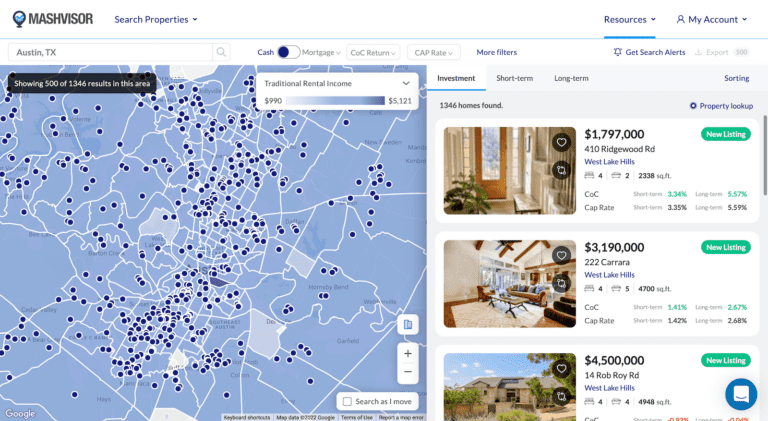
Mashvisor’s November 2022 data shows that the monthly long term rental income in Austin, TX could go as high as $5,000.
Find cash flow Austin investment properties using Mashvisor.
3. The Sacramento Housing Market (Metro)
The Sacramento metro was recommended to real estate investors by Pratik Pathapati of Rework Cash Offers. As of January 2026, it’s considered a strong buyer’s market.
With growth in healthcare, government, and education, the job market in Sacramento, CA continues to grow and show resilience. The city is one of the top 3 in the state for population growth.
One thing to keep in mind, however, is that California has instated new laws that will impact Sacramento landlords. These include:
- Landlords must provide working stoves and refrigerators in rental properties
- “Before” and “After” photos must be taken and saved
- If a deposit payment is made electronically, it must be returned electronically (unless otherwise agreed upon with the tenant)
- A landlord can no longer charge for professional cleaning unless it’s necessary to return the rental to its move-in state
- Tenants who miss rent due to delays or interruptions in Social Security benefits can use this as viable legal defense against eviction
- Processing fees have been banned and tenants should be able to opt out of bulk internet or satellite services if offered
- Stricter policies on how evictions or court summons are served
- Landlords are responsible for cleaning the rental property after a natural disaster and cannot charge rent if a government issued evacuation is in place or if the rental is deemed uninhabitable
While some experts are recommending you stay out of California this year if you want to become a landlord, no one can deny that Sacramento still has the fundamentals for building a successful real estate business for the long-term. You just have to be sure you are in compliance (and can afford) the new rules. You won’t succeed here as a “casual landlord.”
Find cash flow Sacramento investment properties using Mashvisor.
Just Remember…
While we’ve established that the US housing market forecast for 2026 is a positive one, micro market trends will change as you move across the map. One city will find prices increasing while another watches them drop. Demand is rising in strong job markets as it falls in markets that can’t keep up with employment of the population.
So how should you make your final real estate investing decisions? Use the data. Mashvisor is one of the leading real estate data providers in the US market. Using our tools, you will be able to:
- Find top neighborhoods for real estate investments
- Identify cash flowing rental properties for sale before other buyers
- View reliable property projections like cash on cash return, cap rate, Airbnb occupancy rate, and more
- Get access to an Airbnb calculator that will help you forecast whether a rental property will perform better as a short term or long term rental
To learn more about how Mashvisor can help you find profitable investment properties, schedule a demo.