
Is a real estate investment a good idea in 2026? Even with the housing market shifting, real estate is a great long term investment for generating wealth.
When investing, several things must be considered: the purpose of the investment, where it will be done, how much funds will be invested, and so on. But when is the best time to invest in real estate? Let’s explore if 2026 is the year to make your move in the housing market.
Table of Contents
- Is Real Estate a Good Investment in 2026?
- What Is the Best Real Estate Investment?
- How to Invest in Real Estate
- 11 Real Estate Investing Tips
Is Real Estate a Good Investment in 2026?
The US real estate market is one of the most solid in the world, and it is anticipated to stay so for the years ahead. So it’s safe to say 2026 will be a good time to make real estate investments.
Experts in the US real estate industry business agree that 2026 is the year of rebalance. For the past few years, we’ve been calling the market a seller’s market. But things are shifting and buyers are going to have more power this year.
While there is still a clear housing deficit, NAR data shows that inventory is increasing across the nation, up 20% from a year ago. As of late January 2026, the 30-year fixed mortgage rate is 6.01%, 79 basis points lower than this time last year.
Though this combination won’t lead to a full-blown buyer’s market, we’ll see that, backed by lower mortgage rates, buyers will have more choice. The time of heated bidding wars on property is behind us.
Will US home prices drop in 2026? Is a housing market crash in the forecast?
No. So far, no expert is sounding the alarm. But overall, affordability is improving.
Home price growth is expected to slow down this year, on average. Even with a cooldown, rising property prices and increased demand benefit individuals with investment properties in desirable real estate markets.
Knowing that the real estate housing market trends favor investment in 2026, you now have to ask a different question:
“Is Real Estate a Good Investment Right Now for Me?”
There is no “best” or “worst” time to invest in real estate.
The truth remains that it is always a good time to invest in real estate IF the numbers on your deal make sense and you can manage illiquidity.
To truly decide if investing in real estate is a good idea for you in 2026, let’s:
- Look at the real estate investment pros and cons
- Review the best real estate investment strategies
- Learn how to invest in real estate
After which, you can walk away confident in your decision making.
Advantages of a Real Estate Investment in 2026
1. Real Estate Is Still a Reliable Investment
When you successfully enter into the real estate business, you become the owner of a coveted physical asset with a value. There will always be a need for homes, regardless of the economy’s condition.
And even though real estate is a long term investment and it might take several years to witness a return, the advantages are apparent. Real estate investors often see their property prices rise over time. In fact, median US home prices have more than doubled since 2005. Even though they fell dramatically during the 2008 crash, they eventually recovered and then some.
And besides real estate equity growth, a well-managed rental property investment in a market with rental demand will produce reliable cash flow.
For such reasons, real estate will remain a secure and successful investment for many years.
2. Rental Demand Will Remain Steady in 2026 Which Means a Stable Income
According to a recent study, competition for rental properties was very high for 82% of the US markets reviewed. This meant that the average days on market for a rental property was low, occupancy rates high, and a single unit saw multiple prospective tenants. Even though rental rate growth slowed down during 2025, demand did not thanks to the high cost of buying a forever home and the freedom that renting provides.
Consequently, investors who purchase rental homes can expect to generate a monthly cash flow and consistent income. The average rent in the US at the end of 2025 was $1,901.
3. There Are New Tax Advantages for Real Estate in 2026
Money-saving tax advantages are one of the primary reasons why people invest in real estate. For example, investors can deduct the interest they plan to spend on their mortgages from their taxes. The tax deductions can result in substantial savings over the duration of the loan. Furthermore, owners of rental properties can subtract a number of costs from their taxes, such as maintenance and repairs.
Thanks to the One Big Beautiful Bill Act, even more real estate tax incentives will exist in 2026 including:
- The permanent restoration of 100% bonus depreciation
- The increase of Section 179 deductions
- The extension and improvement of Qualified Opportunity Zones
- The introduction of a new 100% deduction for qualified production property
- The establishment of permanence for Section 199A deductions
Disadvantages of a Real Estate Investment in 2026
1. Home Prices Are Still High
Yes, prices will be climbing much slower than they have been for the past few years. Ultimately, however, it still costs a lot of money to buy a rental property. Zillow reported that the median list price at the end of December 2025 was $396,267.
“Even with progress in affordability, middle-income buyers can afford to buy just 21% of the homes currently available for sale. Before the pandemic, they could afford about 50%. That’s a very dramatic difference, and it shows why we need a targeted approach—homes that align with people’s incomes.” – Nadia Evangelou, NAR senior economist
2. Rental Property Insurance Premiums Will Continue to Rise in 2026
Due to the climate risks in certain states, rental property insurance premiums have been rising dramatically. Landlord insurance costs about 15% to 25% more than homeowners insurance. In 2026, a landlord could pay anywhere between $800 and $3,000 for a 3 bed 2 bath rental property. And in locations where the weather risks and construction costs are higher, a landlord with a high-risk property can expect to pay even more.
Premiums have continued to rise over the years and 2026 will be no different.
Get fast, affordable landlord insurance in 2026.
3. New Rental Regulations Will Come Into Effect This Year
While these vary greatly by location, there are new regulations that will come into effect that landlords must follow. From the new rent cap in Washington State to the Texas “Possession Only” hearings which will mean dragging a landlord through multiple, costly hearings for rental disputes and damage claims, the focus has shifted to protecting renters in major markets.
Related: Invest in Real Estate in the 5 Most Landlord Friendly States
What Is the Best Real Estate Investment?
While our focus has been buying rental property up to here, there are actually several ways to invest in real estate. You don’t necessarily have to take out a house mortgage loan with the hopes of building a nationwide property empire. Here are three of the best real estate investments:
1. Real Estate Investment Trusts
Look into real estate investment trusts (REITs) if you want to invest in real estate right away and with as little money as feasible.
The said public corporations raise cash by selling stock and issuing bonds. The revenues are used to buy and rent real estate assets, such as office buildings, retail malls, multifamily apartment complexes, and warehouses. REITs are obligated to distribute virtually all of their income to their shareholders in the form of dividends.
REITs simplify real estate ownership. Property management companies do all ownership and rental procedures. All you need to do is sit back and receive dividends, usually larger than many stock-type investments.
Similar to any other public corporation, you may buy and sell REIT stock in the marketplace using a brokerage account. As a result, REITs are among the most liquid real estate investments accessible.
You may also purchase shares of exchange-traded funds that own shares of multiple REITs. New investors with little funds can buy additional shares in REIT ETFs through several investing business applications.
Pros of REITs
- The majority of core properties are long-term, cash-producing leases.
- Essentially, they are dividend-paying stocks.
- While they are taxed at your ordinary income rate, most real estate investors can deduct 20% of that income right off the top thanks to Section 199A, effectively lowering their tax bill.
Cons of REITs
- The usual rental real estate leverage is not applicable.
- While we expect the real estate market to be stable in 2026, REITs depend on the stock market which can be much more volatile, especially given the current political climate.
- REIT dividends do not qualify for the typical real estate tax depreciation.
2. Rental Properties
Think about owning rental properties if you want to invest substantially in real estate. Rentals can provide consistent income and the potential for growth over time.
There are two basic ways to profit from rental properties:
- Long term rentals: These homes are typically planned to be leased for at least a year, giving a consistent monthly revenue flow. You might purchase a multifamily or single family home to rent to others.
- Short term rentals: Such properties appeal to rotating tenants whose visits can be as short as one night. While you’re away, you might offer your entire multifamily home or apartment or invest in a second property designed just for short term rentals.
While the rental investment business offers more profit potential, it also demands significant effort. You must locate and screen renters, pay for ongoing upkeep, handle repairs, and handle any other issues that may occur.
Employing a property management company can minimize some of the hassles, but it will affect your profits. Also, the resources and cheaper mortgage rates available for primary residences are not accessible for rental properties. However, the process can be made simpler by employing some of the best real estate apps that are tailored to investors’ specific needs.
3. House Flipping
You do not need to purchase rental properties to optimize your earnings from real estate investment.
Buying and flipping houses is a popular business technique, albeit flipping, like renting out properties, requires a lot of labor. It entails refurbishing properties and learning to spot up-and-coming neighborhoods where you can resell your acquisitions at a profit.
If your house flipping business approach includes remodeling and construction, you are taking on additional risk and spending significant out-of-pocket expenses. To cut a long tale short, it’s more complex than it appears on HGTV.
Building licenses are required for renovations. Remodeling expenses may be greater than expected, especially if you hire contractors or outsource additional work. So look for real estate properties in up-and-coming areas that don’t require major improvements to reduce the effort involved in flipping properties.
Remember that the neighborhood you believe would become popular may never catch on, presenting you with a home that will be difficult to recoup your investment. This may be made much more profitable if you rent out the house while you wait for home values to increase. Although, now you’ll have to learn about owning a rental property and the regulations that come with that.
Pros of House Flipping
- Flips are in high demand among those investing in turnkey properties as in 2026, many want to avoid doing the work themselves.
- It’s possible to get quick returns.
- Capital is tied up for a shorter amount of time.
Cons of House Flipping
- More market knowledge is required.
- Renovation costs can be high.
- Material volatility is a major issue in 2026.
- “Cosmetic-only” flips are hard to find in this market as many real estate investors are snatching them up fast.
- You’ll be taxed differently and often pay more in taxes as a house flipper compared to a long-term real estate investor.
How to Invest in Real Estate
Once you’ve acquired all of the fundamental knowledge and chosen your path, it’s time to begin your investment journey step by step.
Most beginners start with a residential real estate investment. Learning and investing in residential real estate is better compared to commercial real estate, especially if you have less capital or lower risk tolerance.
Below is a step-by-step guide on how to invest in residential real estate.
If you’ve chosen REITs or house flipping as your real estate investment strategy for 2026, check out the following guides to get started:
How to Invest in Real Estate: 3 Step to Get Started
- You should get information from local real estate brokers and investors before embarking on this adventure. Always seek the advice of real estate specialists if you have any doubts. It is all about constant learning in real estate.
- The next step is to identify the ideal location—if your location is excellent, your best investment property will provide a good and consistent return on investment.
- Don’t just buy the first rental property you come across. Find various investment properties and then decide which best meets your investing objectives through in-depth property analysis.
Learn How to Easily Find Great Locations and Assess a Property With Mashvisor
Mashvisor is among the best online real estate apps for investors. It uses reliable data, advanced algorithms, and AI technologies to help you identify profitable real estate assets in any market in the US.
The Real Estate Heatmap Tool
The Mashvisor app will assist you in conducting in-depth neighborhood research. Our heatmap tool provides you with appropriate visual cues and vital information. You can use the heatmap to assess distinct neighborhoods in a given city using the following criteria:
- Listing price
- Long term and Airbnb Cash on cash return
- Long term and Airbnb rental income
- Airbnb occupancy rate
The real estate heatmap can help you swiftly filter down a city’s many neighborhoods to just a few top picks. Additionally, Mashvisor recognizes the need to continue conducting local research. As a result, we offer in-depth neighborhood analyses for every location of the US housing market.
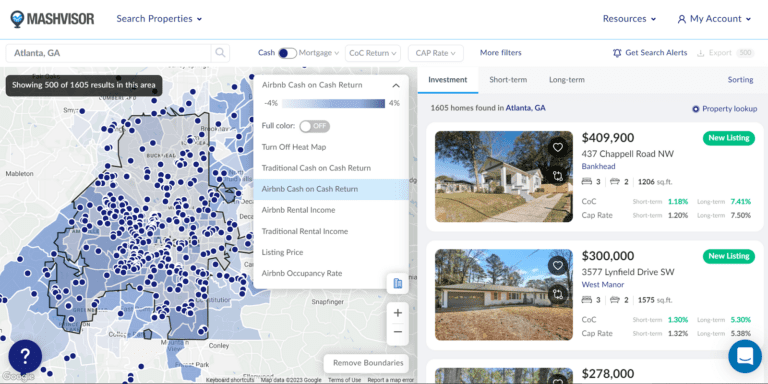
You can use Mashvisor to conduct an in-depth neighborhood study and identify potentially lucrative properties based on their listing price, cash on cash return, rental income, and occupancy rate.
The Real Estate Investment Calculator
Next, our real estate investment software will help you find a great property in the neighborhood of your choice. Our calculator provides statistics on short term rentals, such as Airbnb occupancy data, rental income, cash on cash return, cap rate and more. All of the information is derived from Airbnb listings and is accurate. Similarly, long term rentals data is sourced from the MLS and other reliable locations. The calculator uses this data to find the rental income, occupancy rate, and return on investment metrics for long term rental properties.
Having both sets of data on one platform allows an investor to compare revenue from long term rentals versus income from short term rentals before deciding which path to take.
Mashvisor goes above and beyond other rental data sites by providing rental comps for every listing on the platform.
Sign up to Mashvisor today and find a great real estate investment.
11 Real Estate Investing Tips
- You must learn to understand the tax breaks for real estate investors since they will benefit you in the long term. Engage the services of an accountant to help you with the time-consuming chore of dealing with complex property taxes and deductions.
- You should keep looking for off-market bargain houses and be familiar with the chosen housing market. Real estate investing is a risky endeavor.
- Learn about the dangers associated with real estate transactions. Every type of transaction comes with some level of risk. Rental apartments need maintenance and upkeep, and delinquent renters may necessitate eviction.
- Understand your market and learn about the prevailing real estate conditions. The best investors develop a large real estate network of sellers, buyers, professionals, and anyone interested in real estate investing.
- Examine your credit score and ability to fund real estate ventures regularly. You must also choose a competent bank and the best loan broker to be a successful real estate investor.
- Real estate investment clubs provide educational materials, mentors, and networking opportunities. Join at least one local real estate investment group. A real estate investment club may be valuable for learning, purchasing, and selling property.
- Conduct an adequate screening procedure with renters in the case of rental property investment.
- Investment in real estate is a business. Begin by creating a solid business plan that covers the specifics of starting and running your real estate investing business and realistic goals.
- You should choose a reputable and dependable real estate attorney to get the best assistance. A lawyer can help you comprehend complex real estate legislation.
- Begin with single family houses and work your way up to duplexes or fourplexes, and ultimately apartment complexes as your cash flow and equity grow.
- Try using the best online real estate apps to ease your research work and turn an analysis that usually takes seven days into a 15-minute process.
Conclusion
With the 2026 real estate market heading into a balanced state, real estate investment becomes an even more appealing concept—either as a career or as a lucrative side job. However, like every work, there is a right and wrong approach.
It is not simple to achieve success in real estate investment. Being fortunate with one investment does not equate to being a successful real estate investor. The best way to grow into a successful investor is to learn from and follow in the footsteps of other great real estate investors.
That’s why you should utilize the Mashvisor platform to locate profitable rental homes and thoroughly analyze areas and property.
Are you ready to start your real estate investment journey? Sign up for a 7-day free trial of Mashvisor now, followed by 15% off for life.